

Seed Folk Week 4: Sermon Call To Action
Push Like Mordecai
Esther 4:5–16 | Hebrews 10:24
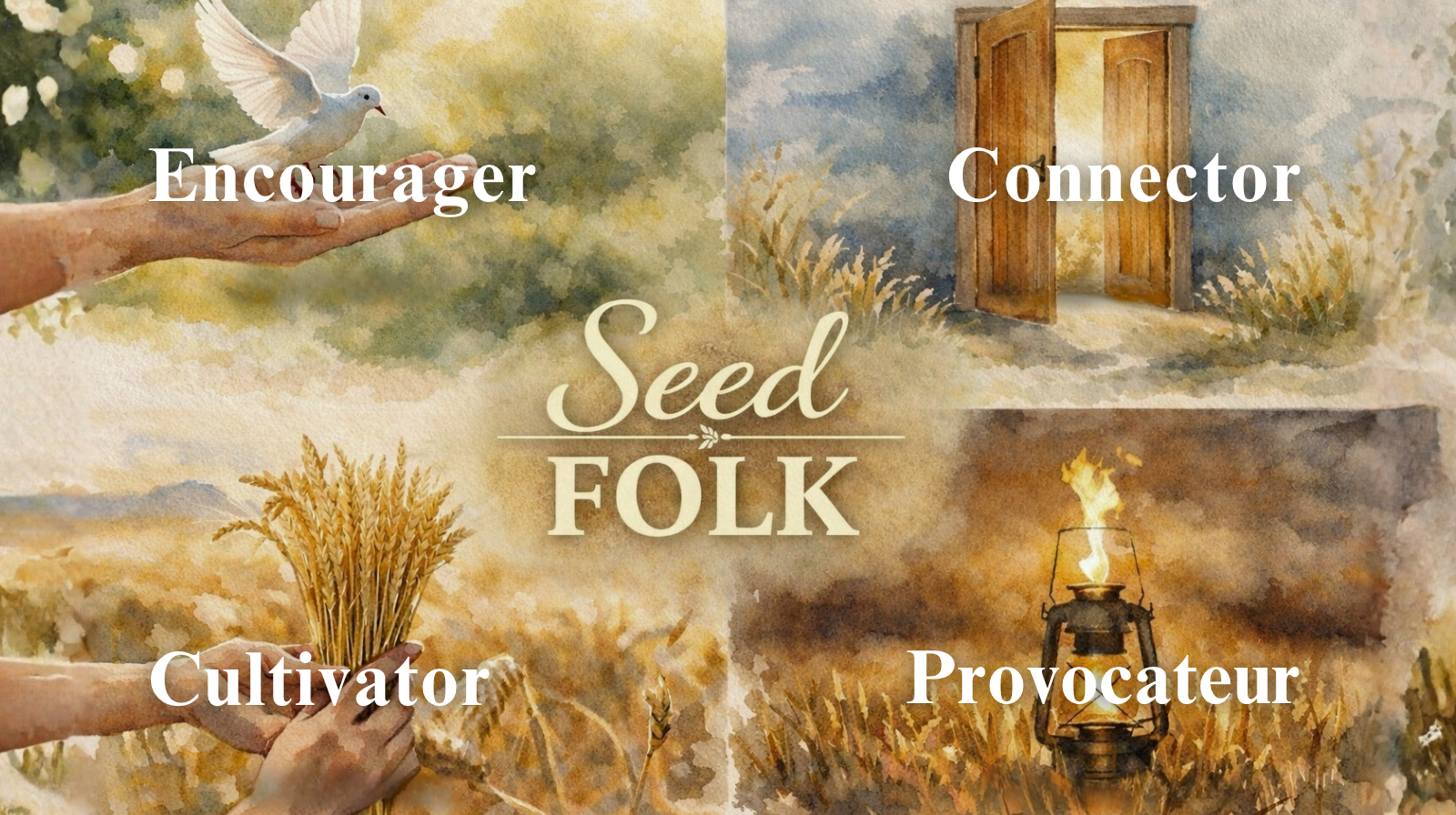
“We all need a nudge sometimes.” In Sunday’s sermon, Push Like Mordecai, we were reminded that God often moves us forward not through comfort, but through provocation. A provocateur is not someone who shames or humiliates, but someone who loves us too much to let us stay stuck. Mordecai plays that role in Esther’s life. When Esther hesitates, Mordecai applies pressure to awaken her calling (Esther 4:8–14).
Newton’s First Law tells us that an object at rest stays at rest unless acted upon by an external force. Spiritually, the same is true. Knowing what God wants is not the same as doing it. We delay. We rationalize. We convince ourselves that God surely has someone else in mind. And so God sends provocateurs, people who refuse to let us settle.
The writer of Hebrews names this responsibility clearly:
“And let us consider how to provoke one another to love and good deeds” (Hebrews 10:24).
The word provoke is intentional. Love that never challenges us eventually stops loving at all.
The book of Esther shows us how fear can shape policy and how injustice can become law. Haman convinces King Xerxes to issue a decree of death by presenting a distorted version of the truth, claiming the Jews are a threat to public order (Esther 3:8–11). The violence is chilling precisely because it is legal. One signature makes an entire people disposable (Esther 3:12–15).
Into this moment, Mordecai hands Esther the written decree and charges her to go to the king and plead for her people (Esther 4:8). Esther now carries the burden of truth-telling. She must confront power, expose deception, and risk her own life. Truth-telling here is not about being right, it is about setting people free (see John 8:32).
Yet Esther also teaches us that not all truth-telling is holy. Haman speaks words that are partially true, but his truth serves sin and self-interest. Esther, by contrast, speaks after prayer and fasting (Esther 4:16), telling the truth at personal cost so that others might live. Scripture reminds us that truth is always evaluated by its motive, not merely its accuracy (see Matthew 7:16).
Before Esther acts, Mordecai issues a warning about the danger of the palace:
“Do not think that in the king’s palace you will escape any more than all the other Jews” (Esther 4:13).
The palace represents any place of comfort where we stop listening for God’s next call. The danger is not disbelief, it is complacency.
Mordecai then speaks one of the most profound truths in Scripture:
“If you keep silence at such a time as this, relief and deliverance will rise for the Jews from another place…” (Esther 4:14a).
The future belongs to God. Deliverance is not in doubt. But participation is.
God’s sovereignty does not cancel human responsibility. Esther must still choose whether she will step forward or stay silent. Inaction does not stop God’s work; it only removes us from it.
And then comes the calling:
“Who knows? Perhaps you have come to royal dignity for just such a time as this” (Esther 4:14b).
Privilege is tied to purpose. Whatever we have, position, education, resources, time, it may be for such a moment as this.
Esther responds with courage, calling for prayer and fasting before she risks everything (Esther 4:15–16). The provocateur has done his work. The push has moved her from fear to faith.
This devotion is not meant to make us comfortable. It is meant to move us from silence to obedience, from settling to surrender, from the palace to the purpose of God.
Reflection Questions
Where in your life have you mistaken comfort for God’s approval?
(Esther 4:13; Revelation 3:15–16)When truth is spoken—by you or to you—who benefits from it being told that way?
(Esther 3:8; Esther 4:16; John 8:32)Is God able to work through you in this season, or has God had to work around your hesitation?
(Esther 4:14; Hebrews 10:24)
Prayer
Gracious and eternal God, You see where we have settled into comfort and called it faithfulness. Forgive us for confusing safety with obedience. Send us holy provocateurs, voices that push us toward love, justice, and good deeds (Hebrews 10:24). Give us Esther’s courage to speak truth, Mordecai’s boldness to push when silence is tempting, and hearts willing to be used in this moment (Esther 4:14–16). Free us from fear that paralyzes and from truth that serves self-interest instead of love. Use what we have and who we are for such a time as this. Amen!
Pastor Briggs
